Stores built to finish the checkout.
A storeʼs job isnʼt traffic or pretty product shots — itʼs completed checkouts. I build e-commerce sites engineered around the buyerʼs journey, so more of the people who land actually buy, and more of them come back for a second order.
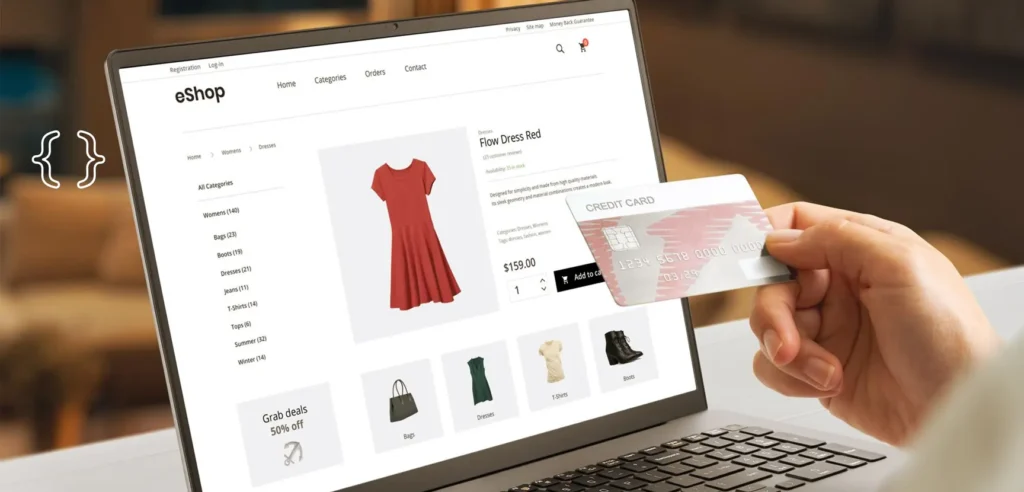
What is conversion-focused e-commerce?
Conversion-focused e-commerce builds a store around the completed purchase — the buyerʼs journey from landing to checkout — rather than around a catalogue. Great visuals donʼt pay the bills; finished checkouts do.
Most stores lose sales for reasons that have nothing to do with the product or the price. The page loads slowly, the descriptions read like SEO filler, the return policy is buried three clicks away, there are no reviews near the “Add to Cart,” and checkout takes six steps on a phone. Traffic arrives, interest is real, and the cart gets abandoned at the last moment because the experience made buying feel risky or like hard work.
So I build the store the way a customer actually moves through it, not the way a designer arranges it. Fast pages so browsers donʼt bounce. Descriptions that sell the transformation, not just list specifications. Trust signals — reviews, guarantees, returns — placed exactly where doubt strikes, which is usually right at the “Add to Cart” and again at checkout. And a checkout stripped to as few taps as possible, especially on mobile, where most carts are won or lost.
Thatʼs the difference between a store that gets traffic and a store that gets sales. But the first purchase isnʼt the finish line — itʼs the start of the relationship that actually makes e-commerce profitable. So the build is set up for return buyers too: accounts, email capture, abandoned-cart recovery and repeat-purchase nudges, so youʼre not paying to acquire the same customer twice. More of the people who already wanted to buy finish, and more of them come back.
Everything that turns a visit into a sale.
A complete conversion website — strategy, design, copy guidance, and a fast, clean build. Every piece exists to turn a visitor into an enquiry on your calendar.
Frictionless checkout
Descriptions that sell
Trust at the point of sale
Fast product pages
Built for return buyers
SEO-ready & AI-ready
Crawlable product structure, and
support chat that can be automated.
- Conversion-first copywriting guidance
- Responsive across every device
- Analytics & event tracking setup
- Accessibility (WCAG) best practices
- Reusable components & design system
- Smooth, deliberate micro-interactions
Sites that performed.
A few conversion websites I’ve shipped recently — each one measured by results, not aesthetics.
PlannerCo

HearthGoods

PureForm
From idea to live site.
A proven four-phase process that gets you a high-converting site fast — without the chaos.
Map the journey
Build the store
Reduce friction
Recover & grow
Abandoned-cart flows, email capture, repeat-purchase nudges and AI support.
the cross - sell
A store finishes the sale — automation keeps the customer.
The first purchase is the start of profitability, not the peak of it. The customers who cost the most to acquire are the one-time buyers; the ones who make you money are the ones who come back — and whether they come
back is a matter of systems, not luck.
AI and automation handle abandoned carts, answer product questions instantly, recover the buyers who hesitate at checkout, and bring people back for the second and third order.
So your store isnʼt just converting once — itʼs building repeat revenue on autopilot, turning a single sale into a customer instead of a transaction.
own table · Local SEO Growth add-on included surprises.
Every package is built to pay for itself in booked jobs. Fixed quote before we start — no hidden fees. You see the design before you pay a cent of the build.
Store Launch
- 1 high-converting page
- Lead form + basic funnel
- Mobile & speed optimized
- 1 round of revisions
Store + CRO
- Everything in Store Launch
- Checkout friction removed
- Selling descriptions
- Reviews at point of sale
- Speed & conversion tuning
Store + Automation
- Everything in Store + CRO
- Abandoned-cart recovery
- AI product support
- Email & repeat-purchase flows
- Ongoing optimization
Local SEO Growth from $500/mo
Ongoing · cancel anytime
- Google Business Profile optimization
- Reviews engine (AI-triggered)
- “Near me” & map-pack rankings
- Citations & NAP consistency
- Local & service-area content
- Monthly rankings → booked-calls report
If the first concept isn’t right, walk away — no invoice, no hard feelings. Every monthly plan includes AI tuning, follow-up optimization, CRM upkeep, and a monthly booked-lead report. Cancel anytime — no lock-in.
Common questions.
Whichever fits your catalogue and team — Shopify, WooCommerce or a custom stack. The platform serves the store, not the other way round, so I recommend the right one for your product count, order volume and how hands-on you want to be. Thereʼs no single best platform, only the best fit for you.
Almost always the experience, not the product. Slow pages, weak descriptions, hidden policies, no reviews at the cart, and a clunky mobile checkout quietly kill sales at the last moment — all fixable without touching your price. High traffic and low sales is a conversion problem, and conversion problems have solutions.
Yes. Often a focused CRO pass — a simpler checkout, better descriptions, and trust at the point of sale — lifts sales more than a full rebuild would, for a fraction of the cost. The free audit tells you which is the better spend rather than defaulting to the bigger invoice.
Mobile-first, always. Most carts are abandoned on phones because desktop-designed checkouts feel fiddly and slow on a small screen, so the checkout is built for mobile first — as few taps as possible to finish the purchase — and scaled up to desktop, not the other way round.
Yes — with the automation tier, abandoned-cart emails and flows bring hesitating buyers back automatically. These are often the single highest-return automation in e-commerce, recovering sales that were seconds from completing and would otherwise vanish without a trace.
Yes — payment gateways, shipping rules and taxes are configured as part of the build, so the store is genuinely ready to sell on launch rather than half-finished. Youʼre not left wiring up the money side yourself after handover.
Yes. An AI assistant can answer sizing, shipping, ingredient and compatibility questions instantly, right at the point of doubt — turning what would have been an abandoned cart into a completed sale. Support becomes a recovery tool instead of a cost centre.
Yes — crawlable structure, clean product and category markup, and speed are built in as standard. For ranking product and category pages harder in a competitive niche, youʼd pair the store with an ongoing content and Local/organic SEO retainer.
Yes. If you have hundreds or thousands of products, I build on a stack that handles the volume cleanly and keep the pages fast, because a big catalogue is no excuse for a slow store — and slow product pages are where large catalogues quietly lose their sales.
By building for it deliberately — accounts, email capture, post-purchase flows and repeat-purchase nudges. A one-time sale barely covers the cost of winning it; a returning customer is where the profit lives, so the store is designed to bring people back, not just get them through checkout once.